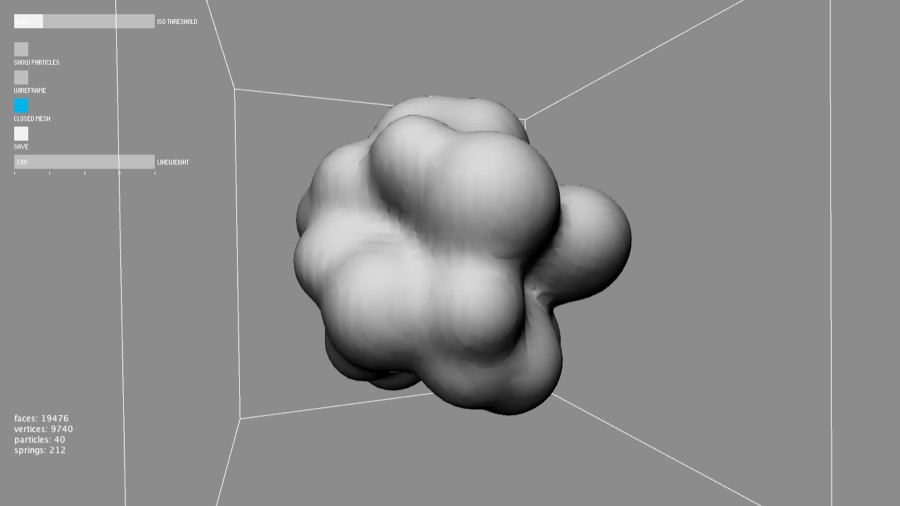
A particle moves through space and leaves a surface behind. Another follows, crosses, or pulls away. Keep the system running and those individual movements accumulate into an object.
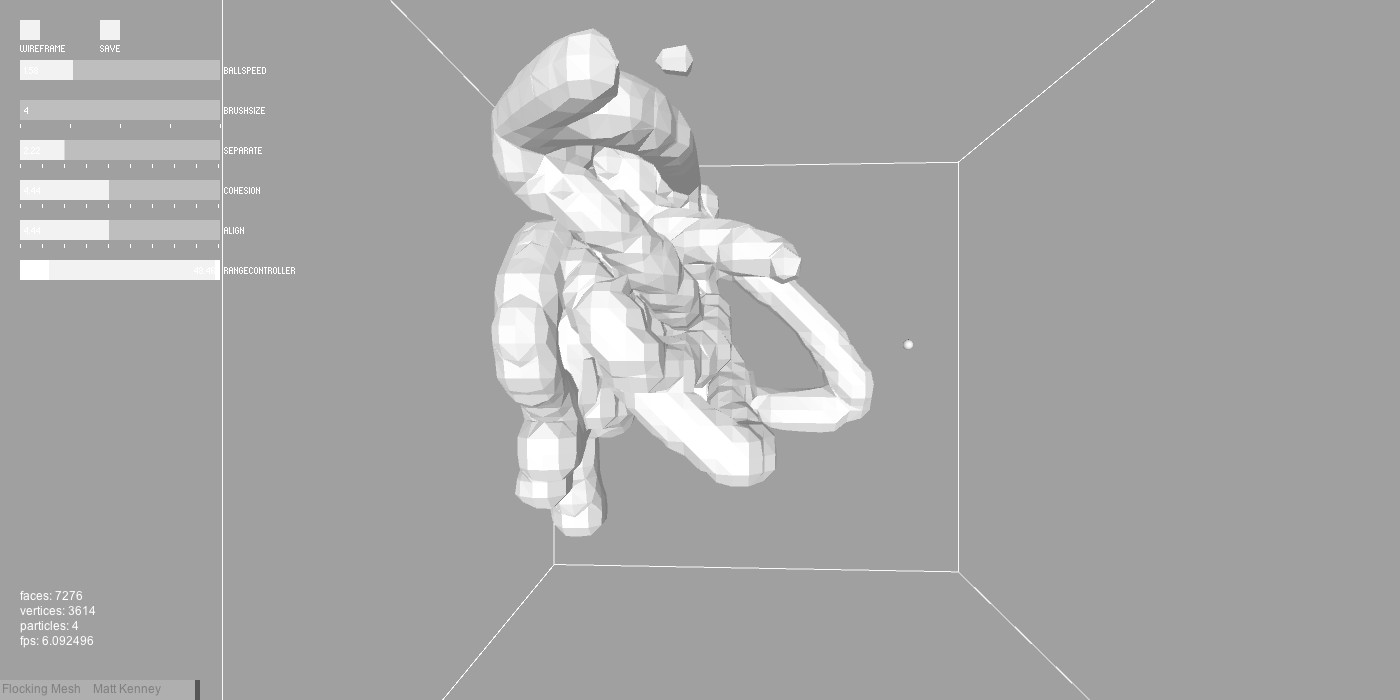
Algorithmic Techtonics II builds form out of duration. I developed this experimental CAD system around flocking particles whose attraction and repulsion can be adjusted in real time. The drawing continues while the rules change, so an intervention becomes part of the geometry.
Give movement a memory.
The first Algorithmic Techtonics experiments wrapped a surface around an evolving network. Here, the particles draw meshes along their paths. Their movement contributes material to the form, carrying a trace of the system forward as it develops.
That shift changes the modeling process. A turn, an expansion, or a cluster of overlapping paths can persist after the particles have moved on. The object begins to hold multiple moments together. Its structure comes from what the flock has done, as well as where it happens to be now.
I was working with a simple proposition: motion can be a way of making geometry. A particle does not need an image of the finished object to contribute to it. It needs a position, a relationship to its neighbors, and a rule for what to leave behind.
Shape the conditions as you go.
Attraction and repulsion give the flock competing tendencies. Changing their strength redirects the movement, which redirects the mesh being drawn. The controls make it possible to work with the simulation as it unfolds, carrying decisions into a form that is still under construction.
The accumulated geometry gives those decisions a different weight. A change in direction can sit beside the path that preceded it. The finished shape can contain both a relatively orderly passage and a more entangled one. It becomes a record of successive behaviors, brought together in a single spatial object.
The designer's attention moves between the local and the whole: the path a particle is taking, the surface it is leaving, and the larger structure beginning to appear. Form emerges at the scale of all three.
Decide when it becomes an object.
The system can save and export its forms as OBJ or DXF files for 3D printing and CNC milling workflows. Export gives the evolving geometry a boundary: this is the state to carry into another tool, another material, another set of constraints.
That last decision is part of the work. A simulation can continue to move; an object needs a moment to stand for it. Algorithmic Techtonics II makes that moment something the designer chooses, after spending time inside the process that produced the form.